Community Shaped the Expectation.
Infrastructure Must Meet It.
Misconception
There are prevalent misunderstandings about the necessity of ASL interpreters in the media and beyond. As recently as January 2025, an American influencer with ~10M social followers on Instagram and X combined, referred to sign language interpreters during emergency briefings as a distraction.
Such views overlook the fact that, for many deaf individuals, American Sign Language is their primary language. It is wrongly assumed that deaf Americans know—or should know—English. American Sign Language differs in grammatical structure from English. Moreover, human interpreters are able to convey nuances that captions often miss, such as non-manual markers; facial expressions, body movements, head positions utilized in sign language to convey meaning. English is the native language for many hearing Americans, who have access to it throughout the United States without any additional expectation placed upon them.
A deeper understanding reveals that many nations have their own unique signed languages, reflecting their local deaf culture and community: Brazilian Sign Language, British Sign Language, Finnish Sign Language, French Sign Language, Japanese Sign Language, Mexican Sign Language, Nigerian Sign Language, and South African Sign Language, among numerous others.
Bottom line: American Sign Language is the native language for many American-born deaf individuals, and English is the native language for many American-born hearing individuals. It is a one-for-one relationship; both are equal.
In an era where information dissemination is instantaneous, ensuring that mainstream broadcasts are accessible to all citizens is paramount. It is only just that picture-in-picture interpretation be routinely implemented in American broadcasting.

Public Figures Including Language Access In Their Riders
What’s a Rider?
A rider is an addendum or supplemental clause added to a contract that expands or adjusts the contract's terms. Riders are commonly used in agreements for public figures to specify additional requirements such as personal preferences or technical needs.
A Simple Yet Powerful Action
Public figures have a unique ability to shape industry standards, and by including language access in their riders, they can make a profound impact with minimal effort.
If you are a public figure, request:
On-site American Sign Language interpretation to ensure that deaf and hard-of-hearing individuals can fully engage with your speeches and live events.
Open captions (burned-in captions) for all live and post-production interview segments to guarantee accessibility across platforms. Doing so makes spoken content instantly accessible to millions of viewers who rely on or prefer captions.
For public figures, adding these 2 requests to a rider is one of the most efficient and immediate ways to promote accessibility. By normalizing language access as a standard expectation, you encourage event organizers, broadcasters, and production teams to adopt these practices universally.
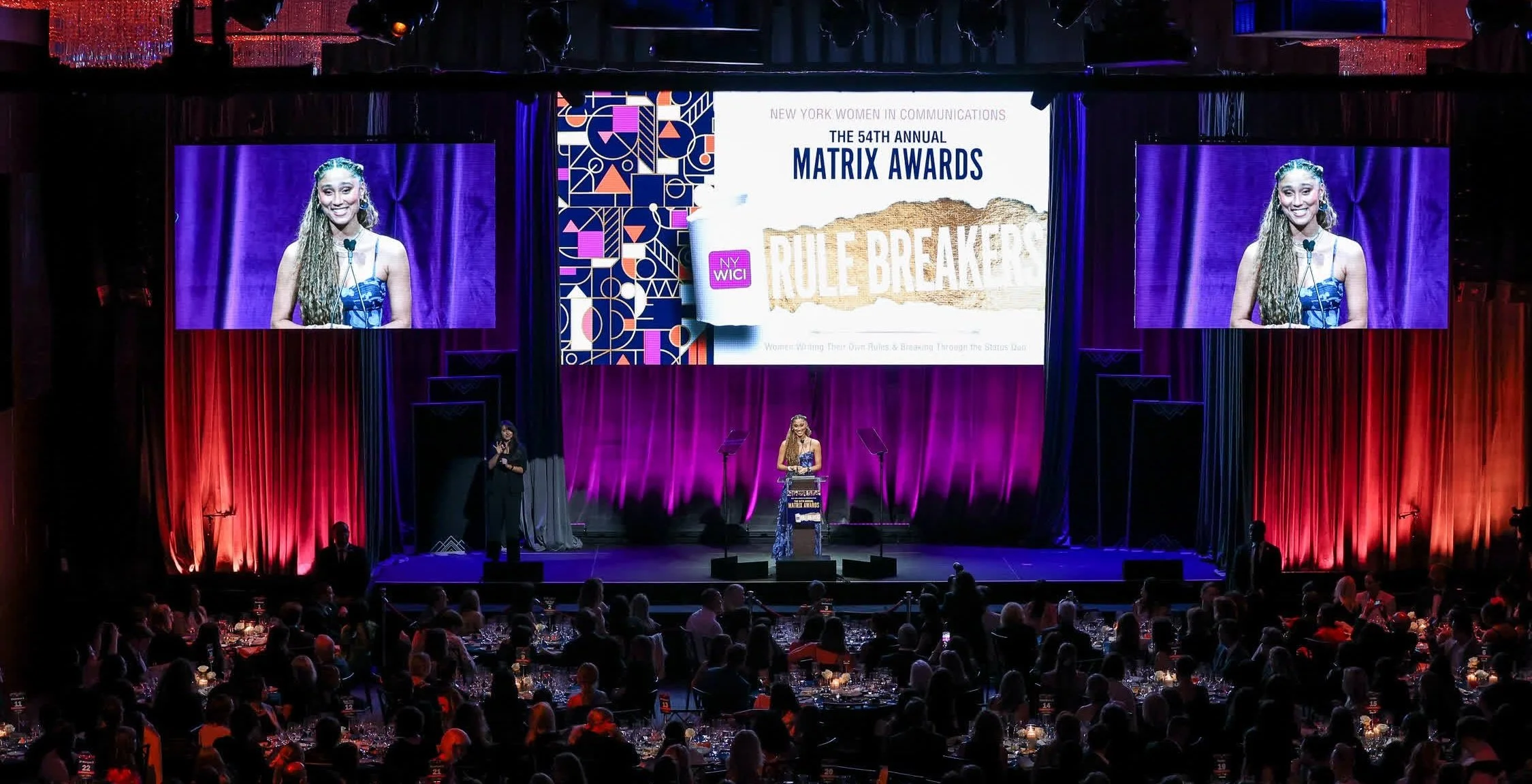
A formal gala taking place at Ziegfeld Ballroom in Manhattan, New York. Gala guests are seated watching Ally Love, a Peloton Instructor and on-air news contributor, standing behind a podium. Ally is wearing formal attire. An American Sign Language interpreter is working near her. Three digital screens are behind them. Prominent text The 54th Annual Matrix Awards.
Where Bigger Stages Come With Bigger Expectations
By prioritizing accessibility year-round, organizations create spaces where disability justice is not just accommodated, but expected—ensuring that every audience member, regardless of needs, has access to information and engagement.
Too often, accessibility is only considered when an immediate demand arises, which leads to rushed or inadequate solutions. While some events may include layers of accessibility, these efforts can fall short when there is a lack of expertise and coordination throughout the process. Thoughtful, proactive planning ensures that accessibility is seamlessly integrated into events, rather than being a reactive measure.
Best practices happen when all key players are involved from the start.
Accessibility leads with combined production and linguistic knowledge who know accessibility is one part of a broader infrastructure.
Production professionals who understand event logistics.
Language experts who ensure accuracy and cultural competency.